Arabic and Calligraphy
Arabic calligraphy explained: the great scripts, master calligraphers, where to see it in mosques and museums, and how to take a private lesson.

Culture
Middle East history is the story of firsts: the first farms, cities, writing and laws, and the birthplace of three world faiths. This timeline of the cradle of civilization walks through twelve thousand years, from Göbekli Tepe to the new museums and skylines you can visit today.
At a glance
Cradle of civilization
No part of the world packs more history into one journey. Between the Nile, the Tigris and the Euphrates, people first planted wheat, built cities, wrote laws and recorded stories. Phoenician sailors spread the alphabet that underlies the letters on this page, and Judaism, Christianity and Islam all took root here. You can walk through much of it in a single trip, from the pyramids of Giza to the rose-red tombs of Petra.
Below is a simple, positive timeline of the eras and milestones that shaped the region, with links to places where you can see them for yourself.
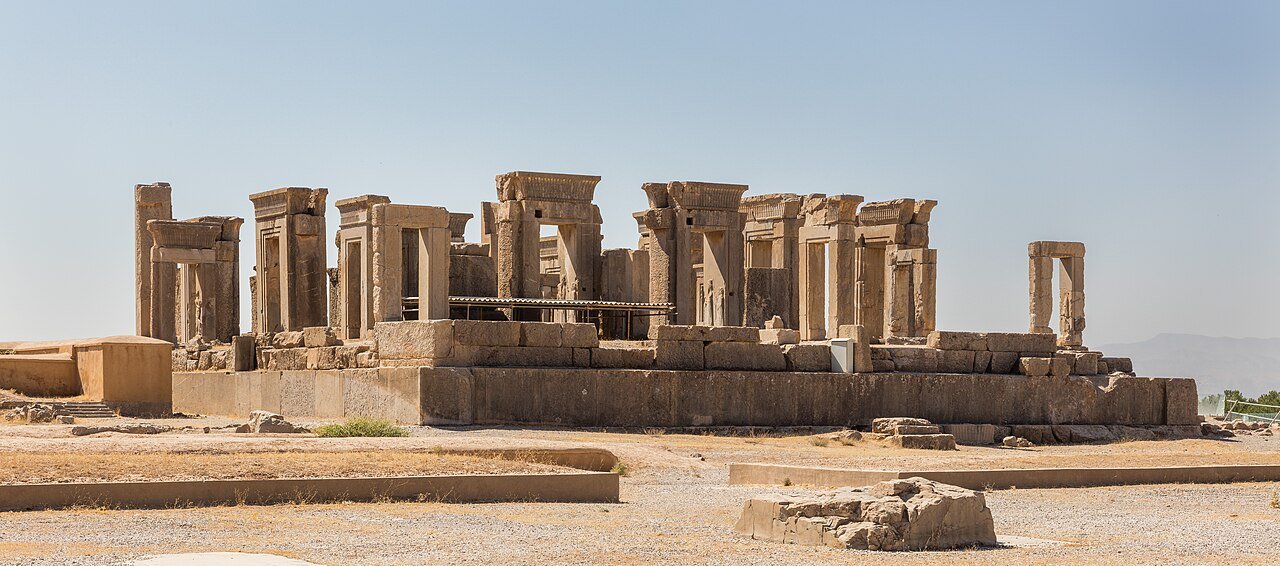
Of Middle East history
| When | Where | Milestone |
|---|---|---|
| About 10,000 BC | Göbekli Tepe, Türkiye | Monumental stone circles built, among the oldest known temples on earth |
| About 9000 BC | Fertile Crescent | Farming begins; wheat and barley domesticated |
| About 8000 BC | Jericho | One of the world's oldest continuously inhabited towns takes shape |
| About 3400–3100 BC | Mesopotamia and Egypt | Writing appears: cuneiform in Sumer, hieroglyphs in Egypt |
| About 3100 BC | Egypt | Upper and Lower Egypt unified under the first pharaohs |
| About 2560 BC | Giza, Egypt | The Great Pyramid completed |
| About 2050–1800 BC | Bahrain | Dilmun flourishes as a Gulf trading hub |
| About 1754 BC | Babylon | Code of Hammurabi, one of the earliest written law codes |
| About 1200–800 BC | Levant coast | Phoenicians spread the alphabet across the Mediterranean |
| 814 BC | Carthage, Tunisia | Traditional founding date of Carthage |
| About 550 BC | Persia | Cyrus the Great founds the Achaemenid Empire; Persepolis follows |
| 332–331 BC | Egypt | Alexander the Great founds Alexandria |
| 1st century BC–AD 106 | Petra, Jordan, and Hegra, Saudi Arabia | Nabataean kingdom at its height on the incense route |
| 1st century AD | Holy Land | Life of Jesus; Christianity spreads across the region |
| AD 330 | Constantinople | Becomes capital of the Eastern Roman (Byzantine) Empire |
| 537 | Constantinople | Hagia Sophia completed |
| 610–632 | Makkah and Madinah | Revelation of the Quran to the Prophet Muhammad; the Hijra of 622 begins the Islamic calendar |
| 661–750 | Damascus | Umayyad caliphate; Dome of the Rock completed in 691 |
| 762 | Baghdad | Abbasid capital founded; the House of Wisdom follows |
| 859 | Fes, Morocco | Al-Qarawiyyin founded, recognized as the world's oldest continuously operating university |
| 969 | Cairo | Fatimids found Cairo; Al-Azhar follows in 970 |
| 1100s–1200s | Region-wide | Era of Saladin and the Ayyubids; great citadels of Cairo and Aleppo |
| 1250–1517 | Egypt and the Levant | Mamluk sultanate; Cairo's finest Islamic monuments |
| 1453 | Istanbul | Ottoman capital; the empire later spans three continents |
| 1500s–1600s | Isfahan, Iran | Safavid golden age; Naqsh-e Jahan Square |
| 1666 | Morocco | Alaouite dynasty established |
| 1727 | Diriyah | First Saudi state founded (Founding Day, February 22) |
| 1744 | Oman | Al Said dynasty founded |
| 1777–1786 | Morocco and the US | Morocco recognizes the United States; 1786 treaty of friendship |
| 1869 | Egypt | Suez Canal opens |
| 1923 | Türkiye | Republic of Türkiye proclaimed, October 29 |
| 1932 | Saudi Arabia; Bahrain | Kingdom of Saudi Arabia proclaimed; first oil found in Bahrain |
| 1946–1971 | Region-wide | Most of today's states gain full independence, from Jordan (1946) to Qatar, Bahrain and the UAE (1971) |
| 1971 | UAE | Federation of the United Arab Emirates founded, December 2 |
| 1985 | Dubai | Emirates airline founded |
| 2010 | Dubai | Burj Khalifa opens, the world's tallest building |
| 2016 | Saudi Arabia | Vision 2030 launched |
| 2017 | Abu Dhabi | Louvre Abu Dhabi opens |
| 2019 | Saudi Arabia | Tourist visas introduced for the first time |
| 2021–2022 | Dubai | Expo 2020 Dubai held, the first World Expo in the region |
| 2022 | Qatar | FIFA World Cup, the first in the Middle East |
| 2025 | Cairo | Grand Egyptian Museum fully opens |
| 2030 and beyond | Riyadh and region | Expo 2030 Riyadh; 2034 FIFA World Cup in Saudi Arabia |
Ancient empires
Egypt, Sumer, Babylon, Assyria and Persia rose one after another, each leaving monuments that still astonish. In Arabia, the Nabataeans grew rich carrying frankincense and myrrh from southern Arabia to the Mediterranean, carving Petra in Jordan and Hegra near AlUla. Read more on our page about the incense route and Silk Road.
Faith, learning
The region is the shared homeland of the Abrahamic faiths. From the 8th century, Baghdad, Cairo, Córdoba and Fes became centers of learning, where scholars advanced algebra, astronomy, medicine and optics; see the Islamic Golden Age. Later, the Mamluks, Ottomans and Safavids built many of the mosques, palaces and bazaars that travelers love today, celebrated on our Islamic art and architecture page.
The 20th century brought new nations, oil and gas wealth, and rapid modernization. Today, ambitious national plans are adding museums, resorts and entire cities, explained on The Visions. For the families who have led many of these states for centuries, see the royal families of the Middle East, and for the region's protected wonders, our UNESCO World Heritage guide.
Ultra-Luxury Real Estate · Own Here
Across the Middle East, the finest resorts and the finest homes now sit side by side, and many international buyers own before they ever visit.
Ultra-Luxury Tourism & Ultra-Luxury Real Estate
Checked October 2026. Prices and dates are approximate and can change. See our standard.