The blue medina
Lanes, stairways and doorways painted in layered blues, best explored early in the morning when they are empty and the light is soft. Photographers love the quarters uphill from the main square.

Home›Destinations›Morocco›Chefchaouen
Morocco
Chefchaouen, Morocco's blue city, is a mountain medina washed in every shade from powder to cobalt. Tucked into the Rif Mountains between Tangier and Fes, it rewards a slow stay in a riad, with waterfalls and hiking trails just beyond the walls.
Updated
At a glance
From the United States
The essentials for American travelers, at a glance.
Checked October 18, 2026. Rules and schedules change, so confirm on the official portal before you book. Connecting on a Gulf or Turkish carrier? See stopover programs, and plan with your first trip.
Founded in 1471 as a small mountain fortress, Chefchaouen grew into a town of Andalusian character, settled by Muslim and Jewish families arriving from Spain. Its famous blue came later and has many stories behind it; today the town keeps the tradition alive, repainting its lanes and doorways so that every turn looks freshly washed.
What makes Chefchaouen special is its pace. After the energy of Marrakech or the vast medina of Fes, this is a place to wander without a map, sit in the main square with mint tea and watch the evening light turn the mountains gold. The medina is compact, safe to explore on foot and full of small workshops selling wool blankets, woven baskets and leather.
It also sits at the edge of real wilderness. Talassemtane National Park, with cedar and fir forest, deep gorges and traditional mountain villages, begins just outside town, which makes Chefchaouen a natural pause on a road trip through northern Morocco.
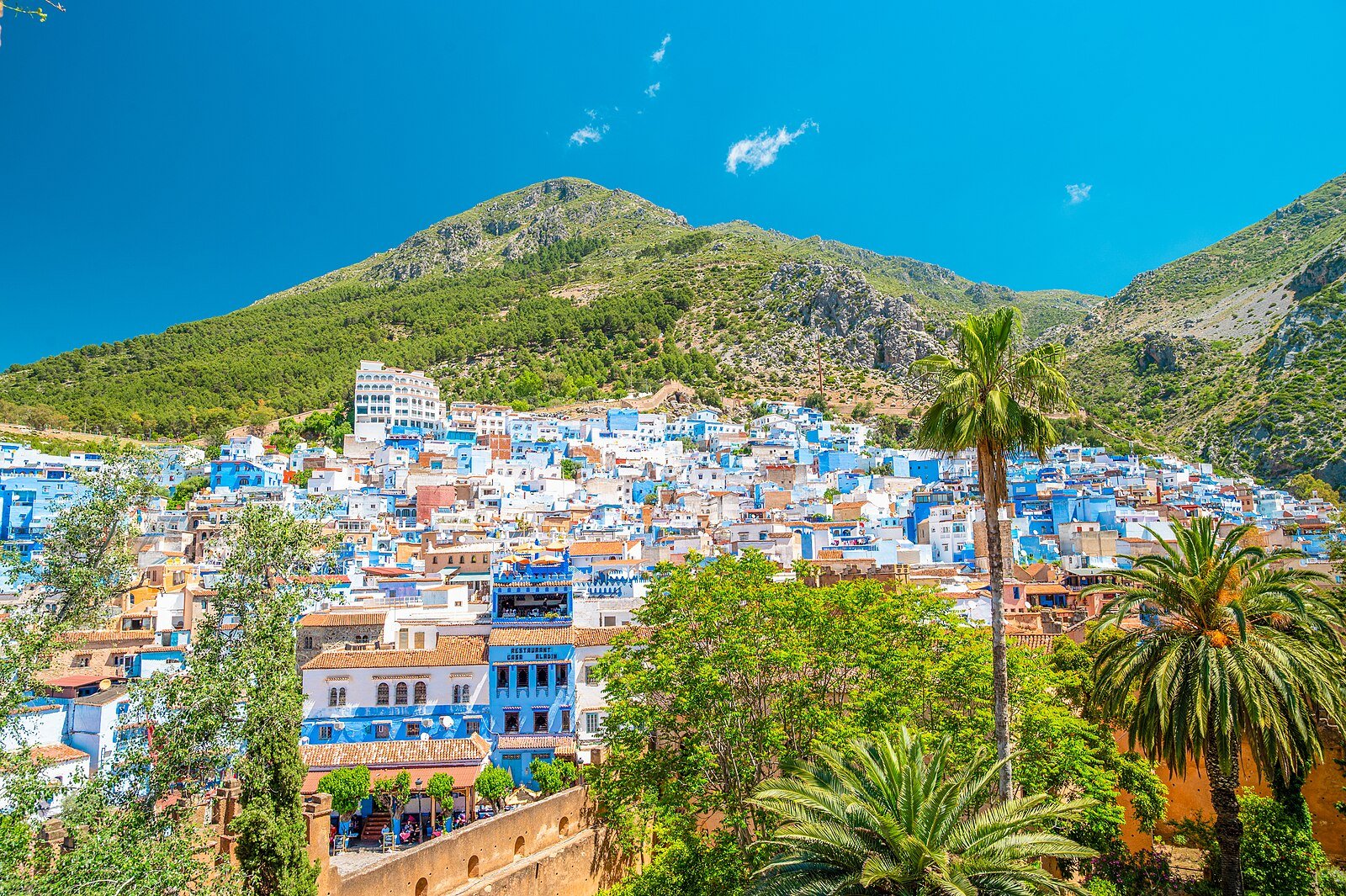
Lanes, stairways and doorways painted in layered blues, best explored early in the morning when they are empty and the light is soft. Photographers love the quarters uphill from the main square.
The main square is shaded by trees and lined with cafes, facing the red-walled kasbah and its gardens. Inside the kasbah, a small ethnographic museum tells the town's story, and the tower offers views over the rooftops.
The fifteenth-century mosque beside the square has a distinctive octagonal minaret. As in most of Morocco, entry is for Muslims, but its exterior is a highlight of the square. See customs and etiquette.
The spring where mountain water emerges at the top of town, with an old washing area and small cafes by the stream. It is the start of the walk up to the Spanish Mosque.
A walk of about 30 minutes leads to a restored hilltop mosque with the best panorama of the blue town. Go at sunset.
About 45 minutes by car, a river trail leads past turquoise pools to waterfalls and a dramatic natural rock arch known as God's Bridge. Hire a local guide and wear good shoes.
Chefchaouen is a town of intimate riads rather than grand hotels; for five-star comfort, pair it with Tangier or Fes.
The most refined stay in the medina, with elegant rooms, an indoor pool and a hammam-style spa. Book well ahead for spring and autumn.
A traditional guesthouse just above the medina, with terraced gardens, a pool and wide views over the town. Quiet and calm in the evening.
For full luxury, base yourself in Tangier or Fes and spend one or two nights in Chefchaouen as part of a private road trip.
From the US, Royal Air Maroc flies nonstop from New York to Casablanca, and from there you can fly or take the Al Boraq high-speed train north to Tangier in a little over two hours. A private driver from Tangier reaches Chefchaouen in about two hours along a scenic mountain road; from Fes, allow three and a half to four hours. Tetouan, about an hour away, has a small airport with limited domestic and European flights.
US citizens do not need a visa to visit Morocco for up to 90 days; a passport valid for the length of the stay is required, with at least one blank page. See our overview of visas and entry.
Spring (April to June) brings wildflowers and comfortable hiking weather; autumn (September to November) is golden and mild. Summer days are warm but cooler than the interior, while winter nights in the mountains are chilly and occasionally snowy. Compare the whole region in when to go.
Living and investing: northern Morocco's appeal is growing with high-speed rail and new roads; our Morocco Luxury Real Estate guide covers how foreigners buy property in the kingdom.
Weather
Average day highs, night lows and rainy days for each month, in Fahrenheit and Celsius side by side. The months in gold are the most comfortable for visiting.
| Month | Day high | Night low | Rainy days | ||
|---|---|---|---|---|---|
| °F | °C | °F | °C | ||
| Jan | 59° | 15° | 41° | 5° | 9 |
| Feb | 63° | 17° | 44° | 7° | 7 |
| Mar | 63° | 17° | 45° | 7° | 12 |
| Apr | 68° | 20° | 49° | 9° | 9 |
| May | 76° | 24° | 54° | 12° | 7 |
| Jun | 81° | 27° | 59° | 15° | 5 |
| Jul | 94° | 34° | 67° | 20° | 0 |
| Aug | 94° | 34° | 67° | 20° | 1 |
| Sep | 83° | 29° | 61° | 16° | 4 |
| Oct | 76° | 25° | 56° | 13° | 7 |
| Nov | 67° | 19° | 49° | 9° | 7 |
| Dec | 61° | 16° | 45° | 7° | 9 |
Averages for 2020–2024, Open-Meteo historical weather (ERA5). Rainy days: days with at least 1 mm (0.04 in) of rain. Weather data by Open-Meteo.com.
One full day covers the medina; two nights let you add the Akchour waterfalls and enjoy the town after day-trippers leave.
Yes, but it is a long day. An overnight stay is far more rewarding, and the town is at its loveliest in the early morning.
There are several explanations, from cooling the houses to traditions brought by Jewish families in the twentieth century. Today the town repaints the blue with pride every year. More in Morocco's history and culture.
Yes. It is small, walkable and relaxed, and the waterfalls make an easy adventure for older children. See family travel.
Ultra-Luxury Real Estate · Own Here
The places you discover as a guest are the places to own. Freehold on most residential property; agricultural land is excluded.
Ultra-Luxury Tourism & Ultra-Luxury Real Estate
Checked October 2026. Prices and dates are approximate and can change. See our standard.