Hadrian's Arch
A triumphal arch built to honor Emperor Hadrian's visit around 129 AD, its three passageways framing the approach to the ancient city. It makes a grand first impression.

Home›Destinations›Jordan›Jerash
Jordan
Jerash, Jordan, is one of the best-preserved Roman provincial cities anywhere, a vast ensemble of colonnaded streets, temples and theaters in the green hills north of Amman. It is an easy day trip from the capital and, with nearby Ajloun Castle, one of the great sights of Jordan travel.
Updated
At a glance
From the United States
The essentials for American travelers, at a glance.
Checked October 18, 2026. Rules and schedules change, so confirm on the official portal before you book. Connecting on a Gulf or Turkish carrier? See stopover programs, and plan with your first trip.
Ancient Gerasa flourished under Rome as one of the cities of the Decapolis, growing rich on trade and farming in the fertile Gilead hills. Much of it was buried for centuries, which is why so much survives: paved and colonnaded streets still marked by chariot ruts, two theaters, grand temples, public baths, fountains and Byzantine churches with mosaic floors. Walking its main street, it is easy to picture daily life two thousand years ago.
Jerash pairs perfectly with a stay in Amman's luxury hotels, and fits into any classic route that continues to Petra, Wadi Rum and the Dead Sea. For background, see Jordan's history and culture.
A triumphal arch built to honor Emperor Hadrian's visit around 129 AD, its three passageways framing the approach to the ancient city. It makes a grand first impression.
A long arena once used for chariot races and athletic contests. Seasonal shows of Roman army drills and chariot racing are sometimes staged here.
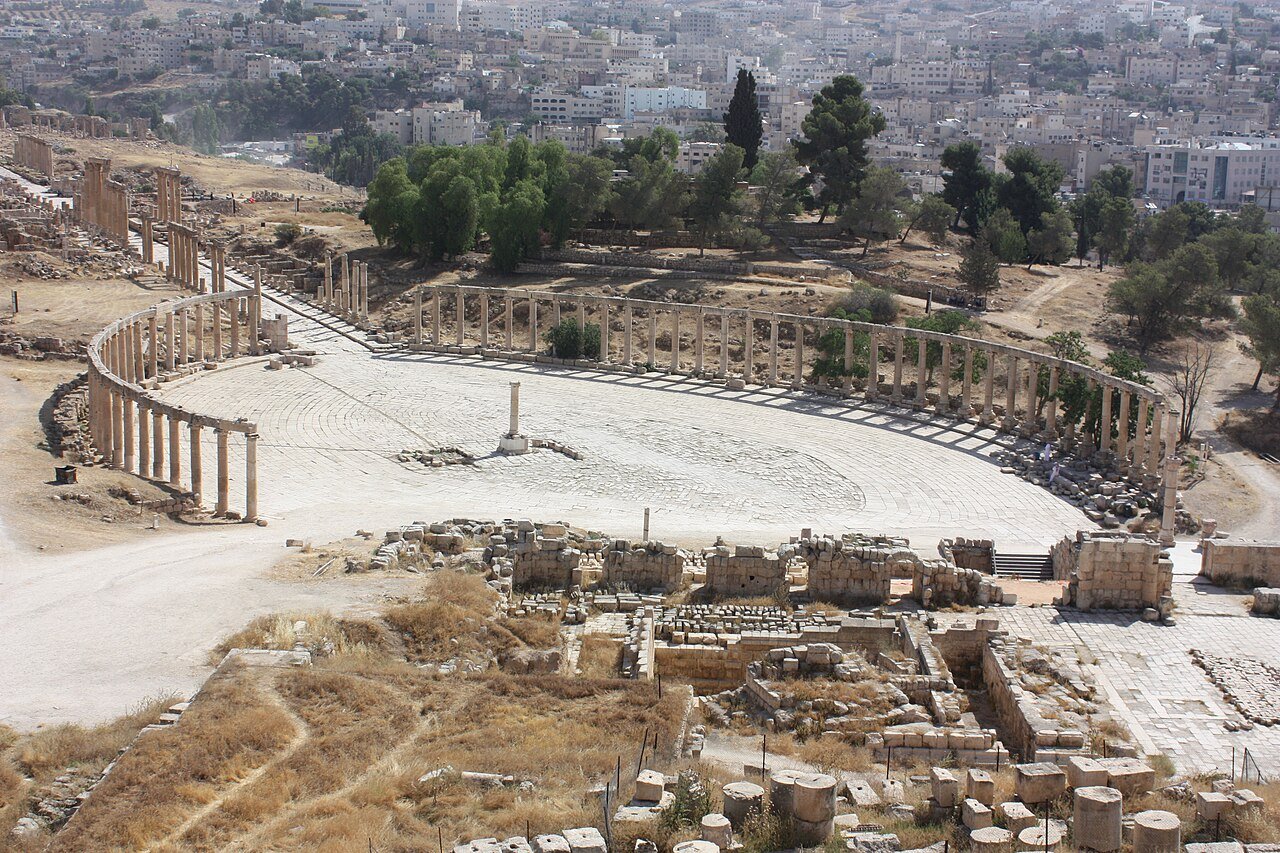
Jerash's signature sight: an unusual elliptical forum ringed by Ionic columns, opening onto the main street. Its graceful shape is unlike almost anything else in the Roman world.
A colonnaded avenue running some 800 meters through the city, its paving stones still grooved by cart wheels, with shops, fountains and crossroads along the way.
The temple of the city's patron goddess, with towering Corinthian columns, rises above the Cardo and offers fine views across the site.
The South Theater seated several thousand and has remarkable acoustics; it still hosts performances during the Jerash Festival. The smaller North Theater is beautifully restored.
Several churches preserve colorful mosaic floors of animals, plants and city scenes, a link to the region's Christian heritage.
A 12th-century hilltop fortress built in the time of Saladin, with sweeping views over pine forests and the Jordan Valley. Combine it with Jerash for a full day.
Jerash has only simple guesthouses, so travelers stay in Amman, under an hour away.
A classic of the capital, set on one of Amman's highest hills, with a lovely spa, outdoor pool and some of the city's best restaurants.
Official site ↗Elegant rooms with sweeping city views, a refined spa and excellent dining, in the upscale Abdoun area.
Official site ↗Butler service, gracious suites and a polished, residential feel in the heart of the embassy district.
Official site ↗A grand hotel with spacious rooms, a large spa and an easy location for drives north to Jerash.
Official site ↗From the US, Royal Jordanian flies nonstop to Amman's Queen Alia International Airport (AMM) from several American cities, including New York, in roughly 11 to 12 hours; see our guide to nonstop flights from the US. Gulf carriers also connect via their hubs. From Amman, Jerash is about 50 kilometers north, under an hour by private car or taxi; many visitors hire a driver for the day and add Ajloun Castle.
US passport holders can obtain a visa on arrival in Jordan, but the Jordan Pass, bought online before travel, is the better choice for most: it waives the visa fee when you stay at least two nights (three days) and includes entry to Jerash, Petra and many other sites. Prices vary with the number of days at Petra, from roughly US$100 (approximate).
Spring (March to May) and autumn (September to November) are ideal, with mild weather and, in spring, wildflowers among the ruins. Summer days are hot, so arrive when the gates open; winter can be cool and occasionally rainy, but crowds are thin. The Jerash Festival of Culture and Arts, one of the Arab world's leading cultural festivals, is usually held in summer, bringing music, poetry and dance to the ancient stages; check festivals and seasons for timing.
Weather
Average day highs, night lows and rainy days for each month, in Fahrenheit and Celsius side by side. The months in gold are the most comfortable for visiting.
| Month | Day high | Night low | Rainy days | ||
|---|---|---|---|---|---|
| °F | °C | °F | °C | ||
| Jan | 57° | 14° | 41° | 5° | 8 |
| Feb | 59° | 15° | 41° | 5° | 7 |
| Mar | 65° | 18° | 46° | 8° | 8 |
| Apr | 78° | 26° | 54° | 12° | 3 |
| May | 85° | 30° | 60° | 15° | 1 |
| Jun | 92° | 33° | 65° | 18° | 0 |
| Jul | 96° | 36° | 68° | 20° | 0 |
| Aug | 96° | 36° | 69° | 20° | 0 |
| Sep | 92° | 33° | 67° | 19° | 0 |
| Oct | 83° | 28° | 60° | 16° | 1 |
| Nov | 70° | 21° | 51° | 11° | 4 |
| Dec | 61° | 16° | 43° | 6° | 4 |
Averages for 2020–2024, Open-Meteo historical weather (ERA5). Rainy days: days with at least 1 mm (0.04 in) of rain. Weather data by Open-Meteo.com.
Allow at least three hours to see the main sights; a full day lets you add Ajloun Castle and lunch in the hills.
Yes. Entry to Jerash is included in all versions of the Jordan Pass, along with Petra and many other sites.
Very little. Bring a hat, sunscreen and water, and wear sturdy shoes for the uneven ancient paving.
It is possible but rushed. Better to spend a day on Jerash and Ajloun and another relaxing at the Dead Sea.
Heritage tourism is central to Jordan's Economic Modernisation Vision, and Jerash is one of its flagship sites.
Ultra-Luxury Real Estate · Own Here
The places you discover as a guest are the places to own. A permit from the Department of Lands and Survey for each property.
Ultra-Luxury Tourism & Ultra-Luxury Real Estate
Checked October 2026. Prices and dates are approximate and can change. See our standard.